
The rules changed on 17 January 2026: a Montenegro residence permit based on real estate is now issued only if the property has a tax-assessed value of at least €150,000. Here is the honest breakdown — which properties qualify, what documents you need, what it really costs, how renewal works, and the limitations that marketing brochures tend to leave out.
What a Montenegro residence permit gives you
A temporary residence permit (privremeni boravak) is a legal resident status with practical benefits:
- Live in Montenegro year-round without the 90-day tourist limit.
- Open a local bank account and use services as a resident.
- Obtain a Montenegrin driving licence and register a vehicle.
- Apply for permits for your spouse and minor children through family reunification.
- Access the healthcare system on resident terms.
- Build a residence record in an EU candidate country.
The key 2026 change: the €150,000 threshold
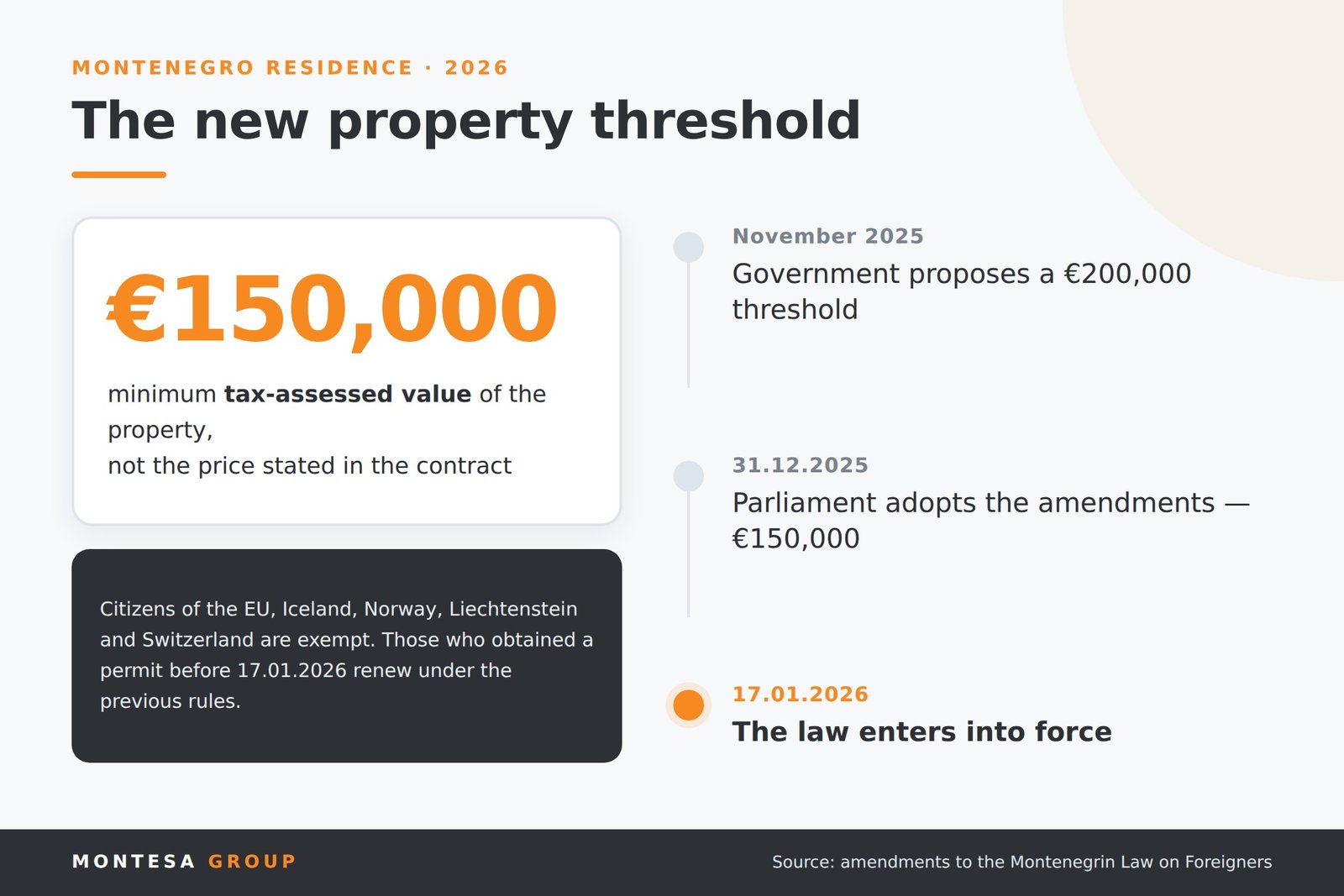
Amendments to the Law on Foreigners were adopted on 31 December 2025 and entered into force on 17 January 2026. What matters:
- Minimum value: €150,000. The government initially proposed €200,000, but parliament lowered the threshold during debate.
- The tax assessment counts, not the contract price. The supporting document is the tax authority's transfer tax decision, showing a taxable base of no less than €150,000. The assessment is usually close to market value but may differ from what you actually paid.
- All property taxes must be settled — outstanding debt blocks both issuance and renewal.
- You must prove not only ownership but actual use of the property.
This gap between contract price and tax assessment is exactly why some buyers were refused in 2026: they bought "with a margin" at €155,000, and the tax authority assessed the property at €138,000.
Who is exempt from the €150,000 threshold
The requirement does not apply to citizens of the EU, Iceland, Norway, Liechtenstein and Switzerland, or to their family members. They are not asked to document property value.
Separately: foreigners who obtained a property-based permit before the law entered into force continue to renew under the previous regime — the new threshold does not apply to them.
Which properties qualify
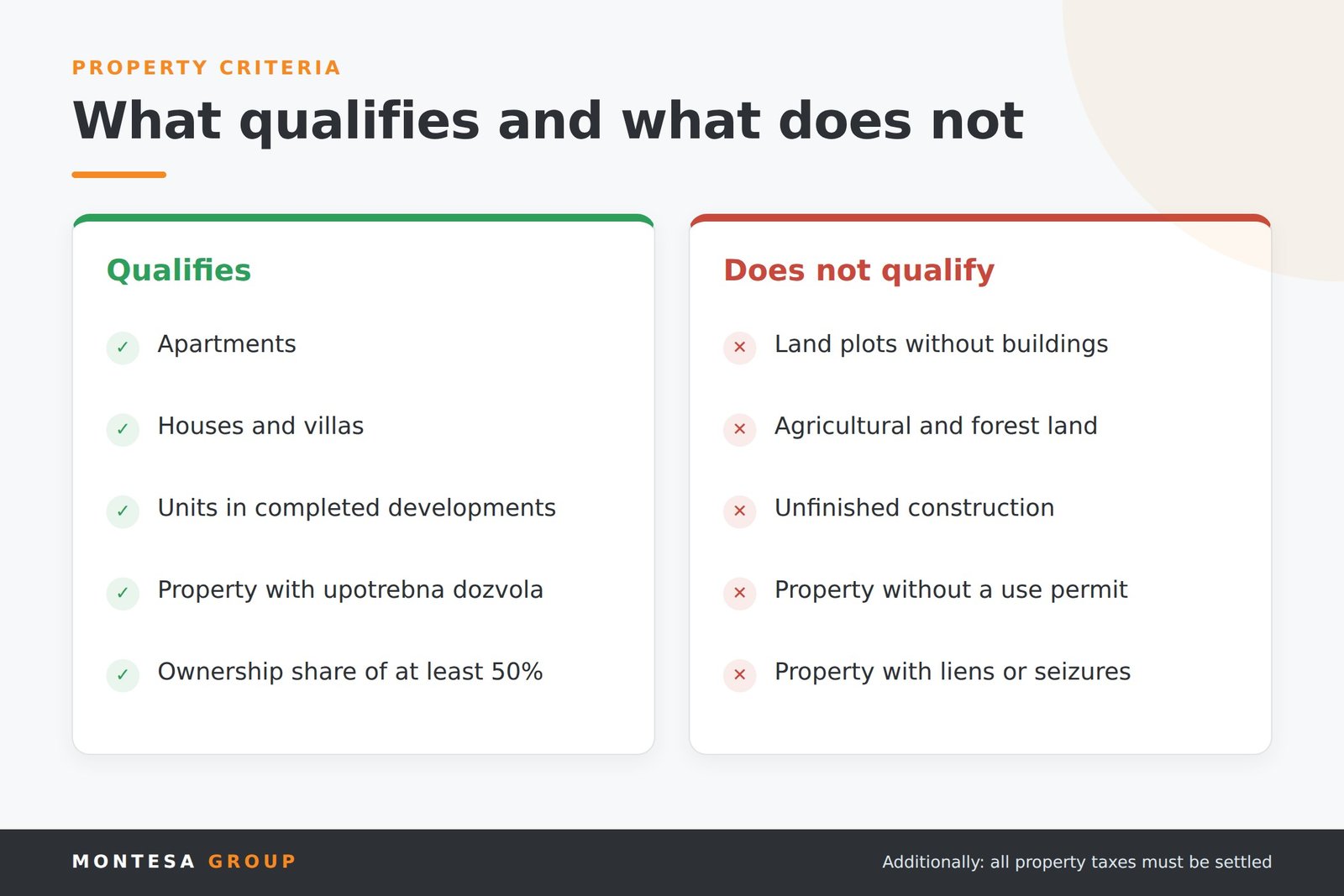
Eligible
- Apartments.
- Houses and villas.
- Residential units in completed developments.
Not eligible
- Land plots without buildings.
- Agricultural and forest land.
- Unfinished construction and buildings without a use permit.
- Properties with liens, seizures or unresolved disputes.
Two conditions people overlook
- Upotrebna dozvola — the occupancy/use permit. Without it a notary will not certify the transaction and the property will not pass review.
- A share of at least 50%. If the property is bought by several owners, your share must be at least half. When buying as a family, calculate this before signing.
Documents required
- Passport with sufficient remaining validity.
- Criminal record certificate from your country of citizenship or residence, apostilled and sworn-translated.
- Cadastral extract (list nepokretnosti) confirming ownership.
- Tax authority decision showing a taxable base of €150,000 or more.
- Confirmation that property tax obligations are settled.
- Health insurance valid in Montenegro.
- Proof of sufficient means of subsistence.
- Registered address confirmation (bijeli karton).
All foreign documents must be apostilled and translated into Montenegrin by a sworn translator. The criminal record certificate has a limited validity period — order it close to submission, not at the start of the process.
Step-by-step procedure
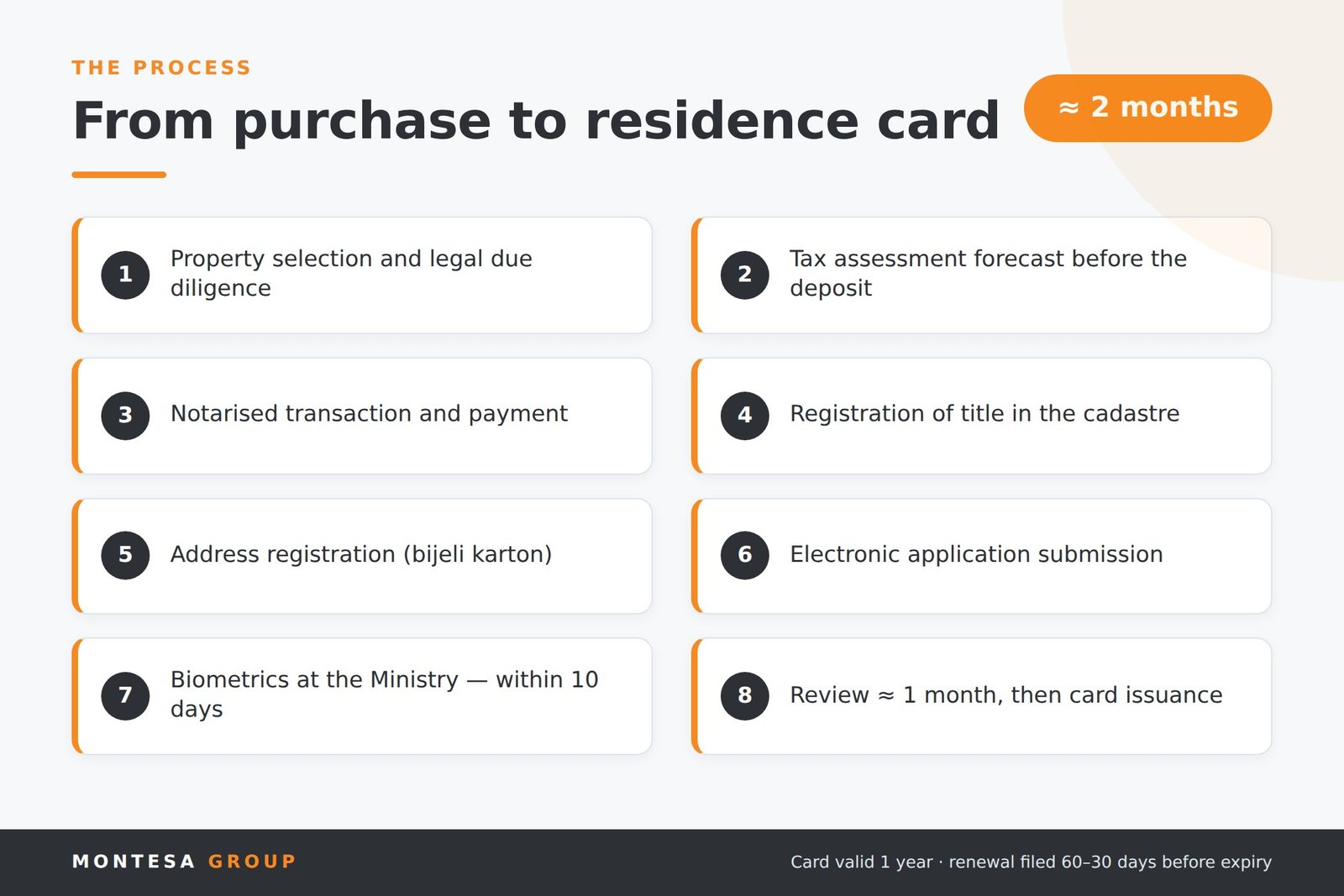
- Step 1. Property selection and legal due diligence. Cadastre, encumbrances, use permit and — critically — a forecast of the tax assessment.
- Step 2. Notarised transaction. Purchase agreement and payment.
- Step 3. Registration of title in the cadastre and obtaining the tax decision.
- Step 4. Address registration with the police.
- Step 5. Application submission. The application can be filed electronically via the government portal.
- Step 6. Biometrics. Within 10 days you must attend the Ministry of Interior office for a photograph, fingerprints and digital signature.
- Step 7. Review and issuance. Roughly a month of police review, then a one-year residence card.
Timeline and budget
A realistic timeline from transaction to card is about two months, provided documents are prepared in advance and the property is clean.
Budget beyond the purchase price:
- Real estate transfer tax — progressive: 3% up to €150,000; €4,500 + 5% on the amount above €150,000; €22,000 + 6% on the amount above €500,000. Buying directly from a developer is subject to 21% VAT instead.
- Notary fees — depending on transaction value.
- Legal support and sworn translations.
- Health insurance — arranged annually.
- Administrative fees for processing and card issuance — modest relative to the transaction.
- Annual property tax — 0.25% to 1% of assessed value, with the exact rate set by the municipality.
Rates are current as of 2026 and may change — we prepare an exact calculation for each specific property.
Renewal and absence rules
- The card is issued for one year and renewed annually while ownership continues.
- The renewal application must be filed 60 to 30 days before expiry. Miss the window and the process starts over.
- At renewal you again confirm: no outstanding property tax and valid health insurance.
- Absence: no more than 30 consecutive days without prior notice to the Ministry of Interior; up to 90 days per year with justified reasons and a written request. Exceeding this is grounds for cancellation.
What this permit does not give you
This matters, because it is where expectations most often go wrong:
- It is not a work permit. The status is tied to use of the property and does not allow employment or business activity in Montenegro. That requires a different basis.
- It is not Schengen. Montenegro is an EU candidate country but not a Schengen member. The permit does not grant free residence in EU states.
- It is not an automatic route to permanent residence — see below.
The path to permanent residence and citizenship
The general rule: permanent residence becomes available after five years of continuous lawful residence, with limits on cumulative absence during that period.
But there is a critical nuance: years spent solely on the basis of property ownership do not count directly toward that five-year requirement. Montenegro treats this status as tied to use of a property rather than to economic integration.
In practice this means that if your goal is not simply legal life by the sea but permanent residence and eventually citizenship, the structure must be planned before you buy — possibly combining grounds or taking a different route from the start. Correcting this three years in is expensive.
Common mistakes that lead to refusal
- Relying on the contract price while the tax assessment came in below €150,000.
- Buying a property without a use permit — the notary cannot complete the transaction.
- Buying land or unfinished construction expecting it to qualify.
- Ending up with an ownership share below 50%.
- Letting the criminal record certificate or another document expire before submission.
- Missing the 60–30 day renewal window.
- Leaving the country for more than 30 days without notifying the Ministry.
How Montesa Group handles this
We work in the Montenegrin property market from the inside — through transactions, not articles. Our approach to residency differs in one respect: we start with the property, not the paperwork, because most refusals are decided at the selection stage.
- Property selection built around the residency goal. Not simply "over €150,000", but properties whose tax assessment will reliably clear the threshold, with a valid use permit and clean cadastral history.
- Pre-checking the tax assessment before you pay a deposit, not after.
- Full legal due diligence with our partner lawyers: encumbrances, seizures, disputes, third-party rights.
- Transaction support — negotiation, notary, cadastral registration, tax formalities.
- Preparing and filing the residency application — sworn translations, electronic submission, accompaniment for biometrics.
- Managing renewals — we track the 60–30 day window so you never lose status to a calendar.
- Strategic advice. If your goal is permanent residence or citizenship, we will tell you honestly whether the property route fits and propose an alternative if it does not.
Request a free consultation — we will assess your situation, give you a realistic budget and timeline, and shortlist properties that genuinely qualify under the 2026 rules.
Frequently asked questions
What is the minimum for a Montenegro residence permit in 2026?
A tax-assessed property value of at least €150,000. The threshold applies from 17 January 2026 to nationals of countries outside the EU/EEA and Switzerland.
Does the contract price or the tax assessment count?
The tax assessment. The supporting document is the tax authority's decision showing a taxable base of at least €150,000, which may differ from the price paid.
I already hold a property-based permit. Do I need to top up?
No. Those who obtained the status before the law entered into force renew under the previous rules.
Can I work in Montenegro on this permit?
No. This status does not allow employment or business activity — that requires a separate basis.
Does a land plot qualify?
No. You need a completed residential building with a use permit.
How long does it take?
Around two months from transaction to card, with a complete document package.
How long can I be absent from the country?
Up to 30 consecutive days without notifying the Ministry, and up to 90 days per year with justified reasons and a written request.
Does a Montenegro permit give Schengen access?
No. Montenegro is not part of the Schengen area.
The 2026 rules are stricter but also clearer: the market is being cleaned of unfinished-build schemes and understated valuations, and those who enter correctly get a predictable, protected status. Life on the coast does not end with the paperwork: we cover yacht charter in Montenegro separately — the licences you need, where the marinas are and what it costs. The key is to calculate everything before the transaction, not after. This article is current as of 2026 and is for general guidance; contact us for a calculation based on your situation.